
Wow. It’s been more than 2 years since my last book review. I’m going to breeze past that cuz I am genuinely embarrassed.
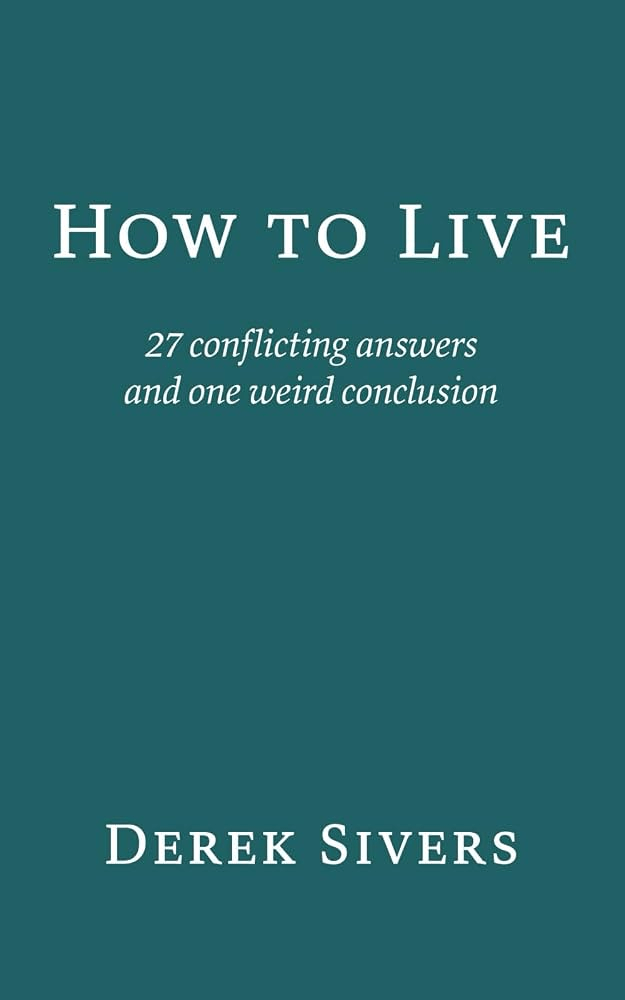
I just re-read How to Live by Derek Sivers, after discovering it 3 years ago, and it still sits with me in a way most books don’t.
The structure is deceptively simple: 27 brief chapters, each one answering the question “how to live” with total conviction – and each one contradicting the last. One chapter tells you to master a skill. The next tells you to balance everything. Another says go all in on love. Another says focus on discipline. Another says do nothing and just watch your breath.
At first this can feel disorienting. Is Sivers just presenting every possible worldview and letting you sort it out? But that’s exactly the move – and it’s the smartest thing about the book.
The complexity is the point
Sivers isn’t confused, and he’s not trying to confuse you. He’s showing you the full range of ways humans have actually chosen to live – and doing it with enough conviction in each chapter that you feel the pull of that answer, even if you know the next chapter will sell you something totally new and different.
That’s the honest version of life. You can become a master of one craft. You can spread yourself across many things and call that a life well-balanced. You can build everything around love, or around loyalty to your culture, or around constant reinvention. None of these are wrong. None of them are the “real” answer that all the others were secretly pointing toward.
Why this matters
Most self-help books sell certainty – do this, avoid that, and you’ll be happy. How to Live refuses to do that, and in refusing, it gives you something more useful: permission.
Permission to notice that there are dozens of legitimate ways to build a life, and our job isn’t to find the correct one. The job is to actually choose – consciously, on purpose – instead of drifting into whichever path happened to find you first.
We’re more limitless than we act like we are. We can be future-focused and present-focused. Disciplined and spontaneous. Devoted to one person or devoted to the world. The book doesn’t resolve that tension. Because the tension isn’t a problem to solve. It’s just what it means to be a person with choices.
The book’s subtitle promises “one weird conclusion,” and it delivers – I won’t ruin it here, but it’s worth reading the whole thing in order to get there. It’s less an answer than a final image that reframes everything that came before it.
Who should read this
Anyone in a season of reevaluating – a career pivot, a creative pursuit, a relationship decision, or just the quiet feeling that you’ve been living life on autopilot. The book doesn’t necessarily tell you what to choose. Rather, it makes the choosing feel like yours again.

